Explanation of Assessment Grading Criteria and Scoring:
|
For this class, we used the same rubric in the beginning as we did in the end of the unit. We didn't weigh any portion of the rubric any different than we did before, making this an identical assessment. Below I have outlined how the unit GLEs created by my partner and I align with our pre- and post-assessment rubric:
Comprehend - Characteristics and expressive features of art and design are used to identify and discuss works of art.
|
Pre-/Post- Assessment Instrument: |
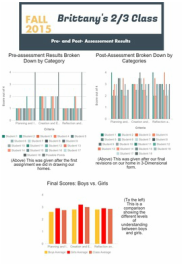
Pre- and Post- Assessment Results
|

To view larger: Click the file above.
| ||
Findings per Students
Student 1: This student started out the class with minimal attention to details and a seemingly disinterest in art. By the end of it all, he was engaged and very creative in making up narratives and stories for what goes on in the town created.
Student 2: This student showed his learning through making revisions. At first he made a pretty good plan, but after observing his fellow classmates, he became inspired and really brought his own personality into the work. Walking around to see everyone's art in the class was very beneficial for this student.
Student 3: This student really shined when given the opportunity to speak about her work. When she was able to say aloud what was happening in her home/town, she was able to decide on what to do next. I found she works best when able to verbally work through any obstacles.
Student 4: This student was very good at adapting to the materials as well as any time constraints (as she wasn't there on one important work day). She doesn't allow not being there set her back from what she wants to do. Very focused and inventive when it came down to making.
Student 5: This student struggled with pushing himself to move forward and focused more on the details of a verbal story rather than a visual one. As we moved on to the city portion of it, he was able to add more detail in his visual story, and felt more capable of spending more time with his art rather than feeling like he was done.
Student 6: This student began his class at a table with many other distractions - mainly other students - at it. Once he was removed from one particular student he was good friends with, he became much more involved in the making process. I noticed that the conversation at his table began to be more about the artwork rather than anything outside of school, as it had been at his previous table. The seat change was good for him.
Student 7: This student had many struggles "getting into" art class. He works very fast and is finished quickly without any regards to the project. This is another student who had a beneficial seat change and was moved near Student 1, who works throughout the entirety of the class time. This seemed to aid this student into working for longer times as well as thinking deeper about any decisions.
Student 8: This student did a great job at remembering and applying concepts we learned in class and was always enthusiastic when he could apply them to his project. Always engaged and able to explain why and how he did something earned him his grades.
Student 9: This student started off very timid about what to make, and slowly but surely gained her confidence in what she was doing. At first she would say "I don't know what to do" but then once we moved on the 3D portion, she took her time and thought about each step of the process carefully and thoughtfully.
Student 10: This student was another one who was indecisive at first. Once she gained a handle on things, she was able to understand what the materials were and even explain it to her peers when they were having troubles. Her product start to finish was just what she had hoped it would look like shown by her original drawings, earning her the grades she did.
Student 11: This student was very energetic in making, sometimes off task. She later became more involved in the work she was producing and knew how to show what she knew verbally. The one downside to her work methods was that she didn't plan or think about what she was making fully and typically just did without getting to the making stage.
Student 12: This student started out very strong knowing what the materials were and how they worked before we taught them. She would say all that she knew but then struggle in the making process by not trying very hard and distracting herself and her friends.
Student 13: This student started out very strong as well, but knowing less that Student 12. She learned a lot and was a great listener and learner. She took her time and translated her home beautifully into 3D while incorporating all that she had learned by mixing every one of her colors with intention and creating a landscape that represented what she wanted her dream home to be.
Student 14: This student had had only slight raise in score because while he did successfully translate some components of his dream home into 3D, there were a lot of things missing. The time he spent in art with us was mostly done conversing or talking about individual aspect of his home (which is wonderful; however, the score would have been higher if it was a finished product).
Student 15: I wasn't sure how this student was going to translate their 2D house into 3D, but this student did a great job of it. The drawing was very flat with minimal detail, and as his ideas grew and transformed, his 3D house became it's own landscape full of organized excitement.
Student 16: This student had some struggles in class, mostly with time management. He missed many days of class, so nothing was ever finished according to what he said he wanted to do, and class time wasn't ever used productively. A lot of teacher guidance was necessary.
Student 17: This student did a lot of exploring in her work through color; but it didn't start out that way. She would mix the same or similar color for a very specific theme she had mentioned prior and then when asked how it may look to use another tool, the whole idea changed and she was able to explore the materials and colors even more-so.
Student 18: This student was great to have in class. He came into our lessons late, but jumped right in. He was able to pick up everything fast and hyper-focus on making his work, and making it to his own standards. Very detail and story oriented.
Student 2: This student showed his learning through making revisions. At first he made a pretty good plan, but after observing his fellow classmates, he became inspired and really brought his own personality into the work. Walking around to see everyone's art in the class was very beneficial for this student.
Student 3: This student really shined when given the opportunity to speak about her work. When she was able to say aloud what was happening in her home/town, she was able to decide on what to do next. I found she works best when able to verbally work through any obstacles.
Student 4: This student was very good at adapting to the materials as well as any time constraints (as she wasn't there on one important work day). She doesn't allow not being there set her back from what she wants to do. Very focused and inventive when it came down to making.
Student 5: This student struggled with pushing himself to move forward and focused more on the details of a verbal story rather than a visual one. As we moved on to the city portion of it, he was able to add more detail in his visual story, and felt more capable of spending more time with his art rather than feeling like he was done.
Student 6: This student began his class at a table with many other distractions - mainly other students - at it. Once he was removed from one particular student he was good friends with, he became much more involved in the making process. I noticed that the conversation at his table began to be more about the artwork rather than anything outside of school, as it had been at his previous table. The seat change was good for him.
Student 7: This student had many struggles "getting into" art class. He works very fast and is finished quickly without any regards to the project. This is another student who had a beneficial seat change and was moved near Student 1, who works throughout the entirety of the class time. This seemed to aid this student into working for longer times as well as thinking deeper about any decisions.
Student 8: This student did a great job at remembering and applying concepts we learned in class and was always enthusiastic when he could apply them to his project. Always engaged and able to explain why and how he did something earned him his grades.
Student 9: This student started off very timid about what to make, and slowly but surely gained her confidence in what she was doing. At first she would say "I don't know what to do" but then once we moved on the 3D portion, she took her time and thought about each step of the process carefully and thoughtfully.
Student 10: This student was another one who was indecisive at first. Once she gained a handle on things, she was able to understand what the materials were and even explain it to her peers when they were having troubles. Her product start to finish was just what she had hoped it would look like shown by her original drawings, earning her the grades she did.
Student 11: This student was very energetic in making, sometimes off task. She later became more involved in the work she was producing and knew how to show what she knew verbally. The one downside to her work methods was that she didn't plan or think about what she was making fully and typically just did without getting to the making stage.
Student 12: This student started out very strong knowing what the materials were and how they worked before we taught them. She would say all that she knew but then struggle in the making process by not trying very hard and distracting herself and her friends.
Student 13: This student started out very strong as well, but knowing less that Student 12. She learned a lot and was a great listener and learner. She took her time and translated her home beautifully into 3D while incorporating all that she had learned by mixing every one of her colors with intention and creating a landscape that represented what she wanted her dream home to be.
Student 14: This student had had only slight raise in score because while he did successfully translate some components of his dream home into 3D, there were a lot of things missing. The time he spent in art with us was mostly done conversing or talking about individual aspect of his home (which is wonderful; however, the score would have been higher if it was a finished product).
Student 15: I wasn't sure how this student was going to translate their 2D house into 3D, but this student did a great job of it. The drawing was very flat with minimal detail, and as his ideas grew and transformed, his 3D house became it's own landscape full of organized excitement.
Student 16: This student had some struggles in class, mostly with time management. He missed many days of class, so nothing was ever finished according to what he said he wanted to do, and class time wasn't ever used productively. A lot of teacher guidance was necessary.
Student 17: This student did a lot of exploring in her work through color; but it didn't start out that way. She would mix the same or similar color for a very specific theme she had mentioned prior and then when asked how it may look to use another tool, the whole idea changed and she was able to explore the materials and colors even more-so.
Student 18: This student was great to have in class. He came into our lessons late, but jumped right in. He was able to pick up everything fast and hyper-focus on making his work, and making it to his own standards. Very detail and story oriented.
Strengths and Weaknesses of the Assessment Plan
The strengths to our Assessment plan was that it was all constant. Being able to see those fundamental necessities in the art classroom change over time through the use of one rubric is a great indicator of what kind of learning is occurring in the classroom. We also used multiple assessments as we went in class in order to see where they were at in their making and how we can tweak the next week's plan to be sure to account for everyone's place in the making, as well as to make sure everyone is enjoying the process and working well.
Some weaknesses to the assessment plan would be that we could have been more in character the whole class time and really made it feel like we were working on real homes and cities. I think it would also be more beneficial to include more types of assessments in their learning to help those who need more time or help on their project.
For more reflections about my assessments and time here, click these links:
Some weaknesses to the assessment plan would be that we could have been more in character the whole class time and really made it feel like we were working on real homes and cities. I think it would also be more beneficial to include more types of assessments in their learning to help those who need more time or help on their project.
For more reflections about my assessments and time here, click these links:
